How do I date a Korean Squier by its serial number?
Date a Made in Korea Squier from its serial: E and S decals (1987–1992), CN and VN (1990s), M, KC and KV. Which factory made it and how to read the year.
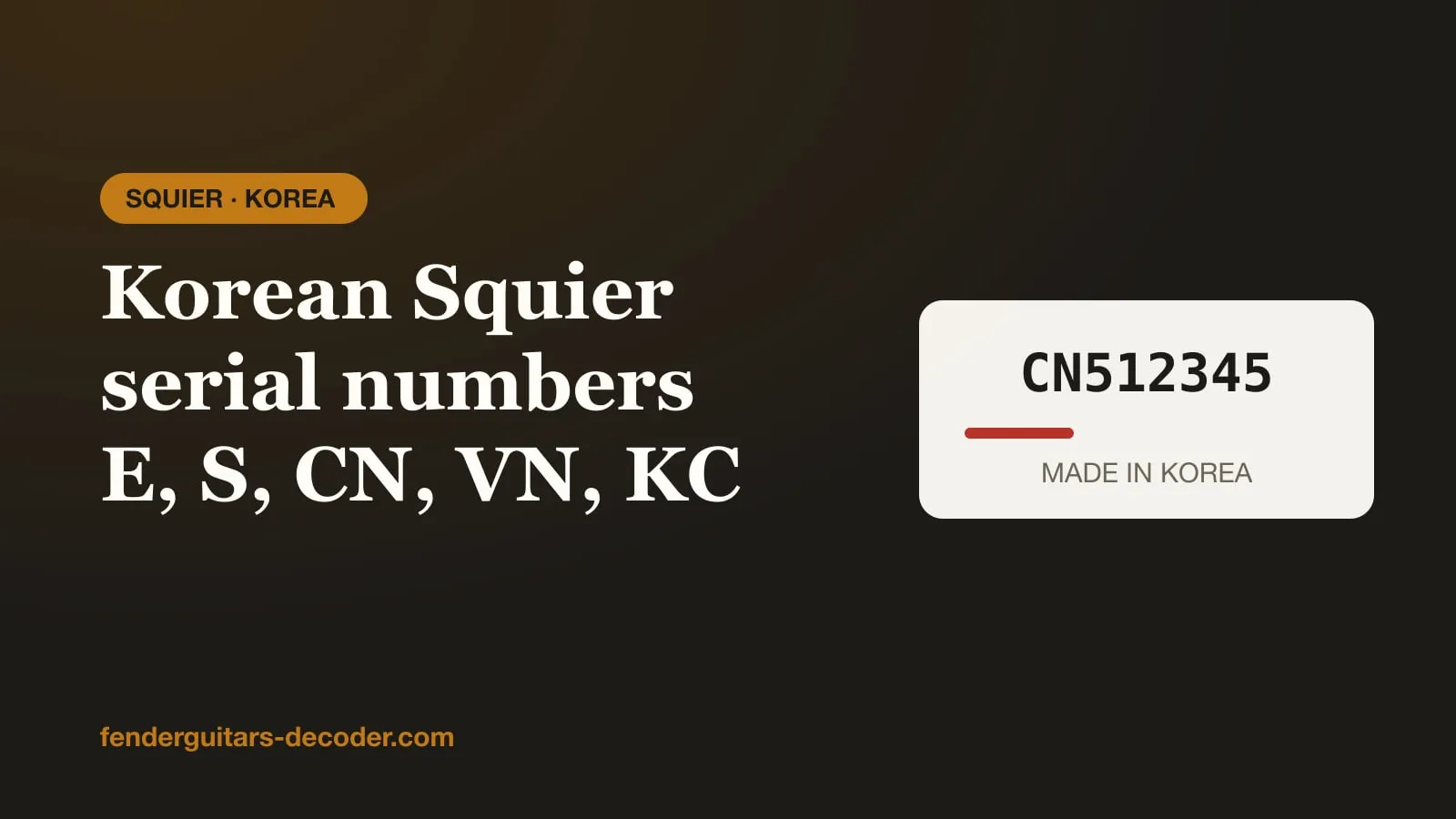
You date a Korean Squier from the letters at the start of its serial, which name the factory, and the digit or digits after them, which on most formats are the year. E serials with a silver decal are Young Chang guitars from 1987–1989, S9 and S1 are Samick (1989–1992), CN and VN are Cor-Tek and Saehan from the 1990s (CN5… is 1995), and KC and KV with eight digits are the last Korean Squiers, where the two digits after the letters are the year (KC97… is 1997).
Key points
- Check the country first. “Made in Korea” or “Crafted in Korea” must appear next to the serial: E, S and CN serials were also used in the USA and Japan.
- E + silver decal: Young Chang, 1987–1989. E9 + black decal: Sung Eum, 1989.
- S9, S1 + black decal: Samick, 1989–1992.
- CN, VN: Cor-Tek and Saehan (Sunghan), 1990s. The first digit is the year.
- KC, KV + 8 digits: Cor-Tek and Saehan, late 1990s. The first two digits are the year.
Why Korean Squiers have so many serial formats
When Fender moved Squier production out of Japan in the late 1980s, it did not use a single Korean factory. According to the Squier Wiki serial tracking table and the Korean Squier histories compiled at fuzzfaced.net, Young Chang built the first Korean Squiers from 1987, Sung Eum and Samick took over around 1989, and from 1992 Cor-Tek (better known as Cort) and Saehan (sold as Sunghan) made them. Each factory printed its own serials, which is why a Korean Squier can start with E, S, CN, VN, M, KC, KV or no letter at all.
Squier never published a factory chart for these guitars, so what follows comes from collector registries that compare thousands of documented instruments. The ranges are reliable enough to date a guitar to within a year or two, but they overlap at the edges, and a few guitars break the pattern.
Korean Squier serial numbers by factory
| Serial | Decal | Factory | Years | How to read the year |
|---|---|---|---|---|
| E1, E7 + 5–6 digits | Silver | Young Chang | 1987–1988 | Production period |
| E2, E8 + 5–6 digits | Silver | Young Chang | 1988 | Production period |
| E9 + 5–6 digits | Silver | Young Chang | 1989 | Production period |
| E9 + 5–6 digits | Black | Sung Eum | 1989 | Production period |
| S9 + 5 digits | Black | Samick | 1989–1991 | Production period |
| S1 + 6 digits | Black | Samick | 1991–1992 | Production period |
| M + 7 digits | — | Not documented | Early 1990s | First digit: M1… = 1991 |
| CN + 6–7 digits | — | Cor-Tek (Cort) | 1990s | First digit: CN5… = 1995 |
| VN + 6–7 digits | — | Saehan (Sunghan) | 1990s | First digit: VN7… = 1997 |
| 6–7 digits, no letters | — | Not documented | Late 1990s | First digit: 7… = 1997 |
| KC + 8 digits | — | Cor-Tek (Cort) | Late 1990s | First two digits: KC97… = 1997 |
| KV + 8 digits | — | Saehan (Sunghan) | Late 1990s | First two digits: KV97… = 1997 |
Sources: the Squier Wiki serial tracking table, fuzzfaced.net and Guitar Insite. They disagree on details: fuzzfaced.net lists M serials with six digits and an M2 for 1992, and Guitar Insite allows a seventh digit on CN serials. Treat the year as the year the decal or neck plate was made, which can be a few months before the guitar left the factory.
Have the serial in front of you?Type it in, choose Korea as the country, and get the factory and the year in one step.
Open the decoderHow to read a Korean Squier serial, step by step
- Find it. The first Korean Squiers have the serial on a decal on the headstock. Later 1990s guitars moved it to the neck plate; collector sources place the change around 1994 or 1995. Here are all the places Fender and Squier put the serial.
- Confirm Korea. Look for “Made in Korea” or “Crafted in Korea” next to the serial. Without it, an E or S serial is far more likely to be an American or Japanese Fender.
- Read the letters. E or S: late 1980s to early 1990s. CN or VN: 1990s. KC or KV: the late 1990s.
- Read the digits. On CN, VN and M, the first digit is the year of the 1990s. On KC and KV, the first two digits are the year.
- Note the decal colour on E and S serials. Silver points to Young Chang; black to Sung Eum or Samick.
Three worked examples: CN512345 is Cor-Tek, 1995. VN7123456 is Saehan, 1997. KC97123456 is Cor-Tek, 1997.
E, S and CN are not only Korean
E serials were used on American Fenders from 1979 to 1990 and on Fender Japan guitars, S serials on American Fenders of the late 1970s, and CN on 1990s Fender Custom Shop guitars. A Korean Squier and a Custom Shop Stratocaster can both start with CN5. The headstock decides it: a Squier logo and “Korea” mean a Korean Squier. If the letters and the country do not agree, read how to spot a fake Fender or Squier.
Telling the eras apart without the serial
If the decal has worn off or the neck plate has been swapped, the logo and the body help. Collector histories describe three looks:
| Detail | What it suggests |
|---|---|
| Silver serial decal, “Squier Series” or Fender-style headstock | Late 1980s, Young Chang |
| Black serial decal, Squier II branding on some models | 1989–1992, Sung Eum or Samick |
| Black Squier logo, thin laminated body on some models | About 1992–1995, Cor-Tek or Saehan |
| Gold Squier logo | From the mid-1990s; sources give mid-1995 or 1996 |
Use these clues to confirm what the serial says, not to replace it. Necks and bodies were often swapped over thirty years, and a replacement neck brings its own logo with it.
Why Fender’s lookup may not find your Korean Squier
Fender’s official serial number lookup covers recent instruments well but is patchy for older Asian-made Squiers. Guitar Insite notes that Korean Squiers made before 1993 are particularly hard to date because so little factory information survives. An empty result is normal for an E, S or early CN guitar and is not, on its own, a sign of a fake. Our guide to what “serial number not found” means explains what to check next.
Are Korean Squiers worth anything?
Korean Squiers from the late 1980s and early 1990s have a following, especially the early silver-decal Young Chang guitars, which many players compare favourably with later budget lines. What one is worth depends on the model, originality, condition and whether parts have been replaced, and the serial only confirms the factory and period. We do not quote prices: compare completed sales of the same model and era on marketplaces and price guides. Our guide on finding a Fender’s value by serial number explains what the serial can and cannot add.
Other Squier countries
If your Squier was not made in Korea, the letters will tell you where it was. Japanese Squiers start with JV, SQ or a single letter (see Fender Japan serial numbers); Chinese ones with C (CY, CGS, CXS…); Indonesian ones with I (IC, ICS, ISS). Here is how to date a Squier Affinity or Bullet, and the full Squier serial chart covers every factory.