How to date a Fender guitar or bass
The serial number gets you to the right decade and usually the right year. Three more checks (neck date, pot codes and features) turn that into a confident date. Here is the whole method, with the charts.
By Joan Queralt · Updated
Decode your serial
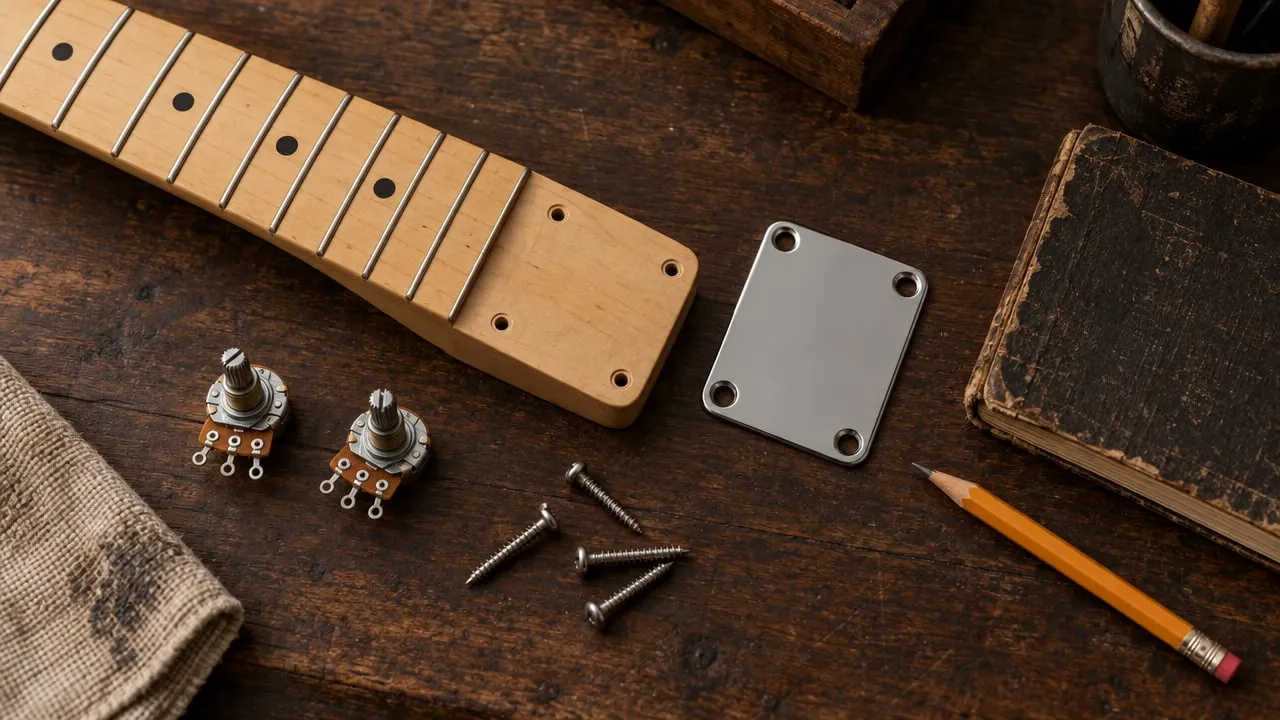
Key points
- Step 1: find the serial: headstock decal (most guitars since 1976), neck plate (1954–1976), or bridge plate (1950–1954 Telecasters and Precision Basses).
- Step 2: read the format. The letters tell you the country and decade; on modern serials the next two digits are the year.
- Step 3: confirm with the neck date, the pot codes and the features. On a vintage guitar these matter more than the serial.
Step 1: find the serial number
Fender moved the serial several times, so where it is already tells you something.
| Location | Typical years | Notes |
|---|---|---|
| Bridge plate | 1950–1954 | Telecaster, Esquire, Precision Bass |
| Neck plate | 1954–1976 | Four-bolt plate; three-bolt on 1971–1981 Strats |
| Front of headstock | 1976–late 1980s | Decal near the logo (S, E, early N) |
| Back of headstock | late 1980s–today | Decal on most Fenders and all modern Squiers |
| Neck heel | 1980s Japan | Only visible with the neck removed |
Reissues copy the originals, so an American Vintage or a Custom Shop Time Machine model usually has its serial on the neck plate even though it is new. Details for each model: where is the serial number on a Fender?
Step 2: read the format
Match the first characters of the serial. Each row links to a year-by-year chart.
| Starts with | Country | Years |
|---|---|---|
| US + 2 digits | USA | 2010–today |
| Z, DZ | USA | 2000–2010 |
| N, DN | USA | 1989–2000 |
| E | USA (also Japan, Korea) | 1979–1990 |
| S, 76 | USA | 1976–1981 |
| 6 digits, F plate | USA | 1965–1976 |
| L + 5 digits | USA | 1963–1965 |
| 4–5 digits | USA | 1950–1963 |
| V | USA (also Japan) | 1982–today |
| MX, MZ, MN | Mexico | 1990–today |
| JD, JV, letter + 6 digits | Japan | 1982–today |
| CY, CGS, IC, ICS, KC, KV… | Squier: China, Indonesia, Korea | 1987–today |
| ICF + 2-digit year | Fender-branded, Indonesia (Cort) | 2009–2012, 2024–today |
| CZ, CN, R, XN | Custom Shop (USA) | 1990–today |
Same letter, different country
E, N, S and V serials exist in both American and Japanese versions, and CN was used by the Custom Shop and by a Korean Squier factory. Always check the “Made in…” or “Crafted in…” text on the headstock or the neck plate. The decoder above asks for it.
This table is for electric guitars and basses. Fender acoustics are dated differently: Fender says their older serials were never archived, so the model name and series give the year. See how to date a Fender acoustic.
Step 3: check the neck date
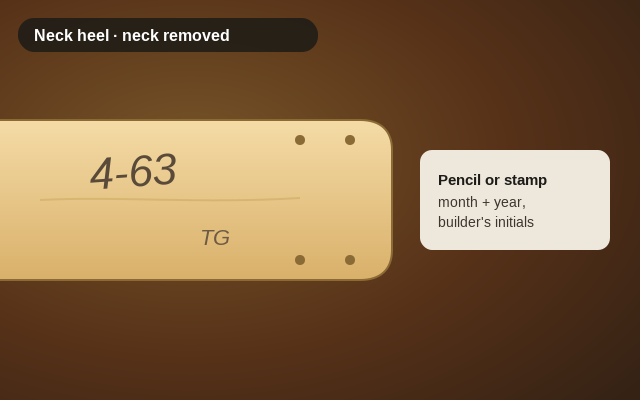
Fender dated its necks at the heel, the end that sits in the body. You need to loosen the strings and remove the four (or three) neck screws to see it.
- 1950s and early 1960s: pencil, often with the builder’s initials and the month and year.
- 1960s: an ink stamp with the day, month and year, followed by a letter for the nut width (A to D, narrow to wide).
- 1970s onwards: stamped codes or printed stickers that include the model and a date.
On a vintage guitar, the neck date is the single best piece of evidence. If it is within a year of the serial range, the two agree. For every stamp format, with examples such as 2 SEP 65 B, see how to read a Fender neck date.
Step 4: read the pot codes
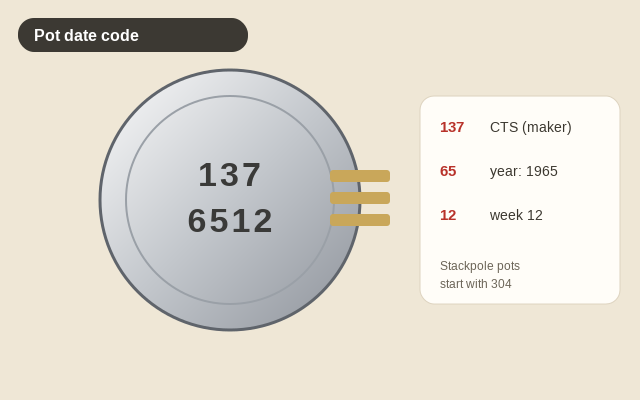
The volume and tone controls are stamped with an EIA code: manufacturer, year and week. Fender mostly used CTS (137) and, at times, Stackpole (304).
| Pot code | Reads as |
|---|---|
| 137 5 46 | CTS, 1955, week 46 (single year digit before the 1960s) |
| 137 65 12 | CTS, 1965, week 12 |
| 304 742 | Stackpole, year ending in 7 (1957 on a 1950s Fender), week 42 |
Pots are made before the guitar, so the guitar is the same age or a little newer. A pot dated after the serial range means the pots were replaced. For every format, the decade problem with one-digit years and what a pot date really proves, see how to read Fender pot codes.
Step 5: check the features
Every era has features that are hard to fake together: the headstock logo, the size of the headstock, the number of neck bolts, the truss rod adjustment, the fingerboard, the bridge and the pickups. For example, a Stratocaster from 1971 to 1981 has a three-bolt neck and a “bullet” truss rod nut; a 1959 to 1962 Strat has a thick “slab” rosewood board. Model-by-model details: Stratocaster, Telecaster, Precision and Jazz Bass.
Why the serial and the year can differ
Decals, neck plates, necks and bodies were made in batches and stored. A guitar finished in January can carry last year’s serial, and in the pre-CBS era plates were taken from a bin with no particular order. Overlaps of up to a year are normal everywhere; the charts on this site show them as ranges rather than pretending to be exact.
Got your serial handy?Type it in the decoder at the top of this page and pick the country printed on the guitar.
Decode it nowOfficial lookup and expert help
Fender has a serial number lookup that recognises many recent instruments. If your serial comes back empty there or in the decoder, run the checks in Fender serial number not found: what does it mean? before assuming the worst. Dating a Fender amplifier rather than a guitar? Amp serials don’t give the year; Fender dates amps by the letters on the QA sticker or the tube chart and by the transformer codes, as explained in how to date a Fender amp. For vintage and high-value guitars, a vintage guitar specialist who can inspect the instrument in person is the only reliable authentication, and insurers often ask for one.