How do I read the date on my Fender neck?
The neck heel date tells you when your Fender neck was made. How to read the pencil dates, the 1960s ink stamps like 2 SEP 65 B, the green codes and modern stamps.

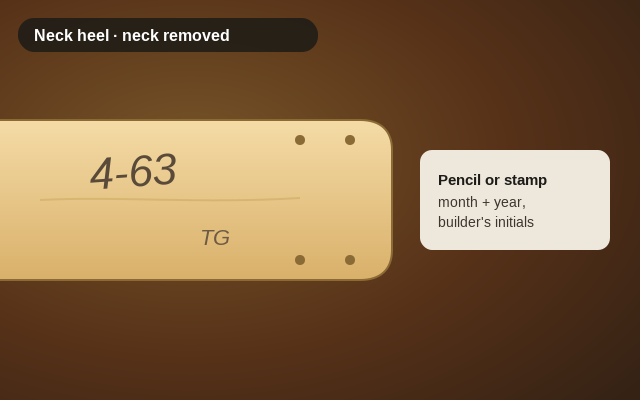
The date on a Fender neck is written on the heel, the end that sits inside the body, so you only see it with the neck off. In the 1950s it is a pencil date (month and year, sometimes with an inspector’s initials); from about 1962 it is an ink stamp read as model code, month, year, nut width, for example 2 SEP 65 B. That date tells you when the neck was made, which is usually a few weeks or months before the guitar left the factory.
Key points
- The neck date is on the heel of the neck. You have to loosen the strings and remove the neck screws to see it.
- 1950s to early 1960s: pencil, month and year (mid-1950s necks may add the day and inspector initials such as TG or XA).
- 1962 to 1969: black ink stamp, model code + month + year + nut width letter. The first number is not the day.
- About 1969 to 1972: green stamps with a numeric month and year, hard to read.
- The date shows when the neck was made. The guitar is as old as its newest original part.
Before you take the neck off
Removing the neck is how you see the date, but it is also how vintage guitars get damaged. Detune the strings fully, lay the guitar on a soft surface, support the neck and the body together and back the screws out evenly. On a valuable or vintage instrument, let a qualified technician do it: cracked finish around the neck pocket and stripped screw holes cost far more than the inspection.
Don’t force it
If the neck is tight in the pocket, don’t lever it out. Old nitrocellulose finish can chip at the edges of the pocket, and that damage is permanent and visible to every future buyer.
Fender neck dates by era
Fender never meant these markings for collectors: they were production notes. That is why the format changed several times and why the dates overlap with each other and with the serial ranges.
| Era (approx.) | What you find on the heel | Example | How to read it |
|---|---|---|---|
| 1954–1956 | Pencil, inspector initials and month-day-year | TG 6-14-55 | Inspected 14 June 1955 by “TG” |
| 1956–1959 | Pencil, month and year | 4-57 | April 1957 |
| Mid-1959 to mid-1960 | Often no date | — | Use the body date, pots and serial |
| 1960 to mid-1962 | Pencil again, month and year | 11-61 | November 1961 |
| 1962–1969 | Black ink stamp | 2 SEP 65 B | Model code 2, September 1965, nut width B |
| About 1969–1972 | Green ink stamp, numeric code | (model code)(month)(year digit)(width) | Month and last digit of the year before the width letter |
| 1980s onwards | Ink stamps, mostly clear dates | varies by factory | Usually a readable year and month, sometimes with model or line codes |
Sources disagree on the exact year Fender moved from pencil to rubber stamp: some vintage specialists describe stamps from 1960, others a return to pencil until mid-1962. Treat the boundary as approximate and read whatever you actually find.
Reading a 1960s ink stamp, step by step
The 1960s stamp is the one people misread most often. Take 2 SEP 65 B as the example:
- 2: the model code. It is a code for the model, not the day of the month. Vintage dealers give 2 and 13 as Stratocaster codes; other models used other numbers, and the codes are not well documented, so don’t try to identify the model from this number alone.
- SEP: the month, as a three-letter abbreviation (JAN, FEB, MAR…).
- 65: the year, 1965.
- B: the nut width.
| Letter | Nut width | Notes |
|---|---|---|
| A | about 1 1/2 in (1.50 in) | Narrow |
| B | 1 5/8 in (about 1.63 in) | The standard width on most models |
| C | 1 3/4 in (1.75 in) | Wide |
| D | about 1 7/8 in (1.88 in) | Extra wide |
A neck stamped B is normal. An A, C or D neck is less common and is something to mention when you describe or sell the guitar, because players look for specific neck sizes.
Does your neck date match the serial?Enter the serial from the neck plate or headstock and compare its year range with the date on the heel.
Open the decoderGreen stamps and the 1970s
From about 1969 to 1972 many necks carry a green stamp that is faint and hard to decipher. The useful part sits just before the nut width letter: the month as a number (1 to 12) followed by the last digit of the year. A code ending in …102B, for example, reads October, a year ending in 2 (1972 in this period), width B. The digits at the start are again a model code.
Through the 1970s neck codes on US Fenders stay inconsistent, and some basses from 1969 to 1980 have codes that are close to unreadable. In that period the serial is on the neck plate until 1976 and then on the headstock, so check what the serial says and use the pots as a second opinion.
Modern necks
From the 1980s onwards neck dates are usually easy to read: a stamp with a clear date, sometimes with model or production codes that Fender doesn’t publish. Japanese Fenders are a special case: their serial can repeat across models and years, and specialists have documented guitars whose serial suggested one year while the neck was stamped more than a decade later. On a Japanese Fender, the neck heel and serial need to be read together.
Some necks from every era have no stamp at all. A missing date is not, on its own, proof that the neck was replaced.
What the neck date proves, and what it doesn’t
The heel date tells you when the neck was finished in the neck department. Necks and bodies were built separately and could wait on a shelf before being assembled, so a guitar is normally a little newer than its neck. The working rule used by vintage dealers is simple: an instrument is as old as its newest original part.
| What you compare | If they agree | If they don’t |
|---|---|---|
| Neck date vs serial range | The serial is confirmed | Plates were used out of order; check the body and pots |
| Neck date vs body date (neck pocket or under the pickguard, mainly to the mid-1960s) | Probably original pairing | One of the two may be a replacement |
| Neck date vs pot codes | Normal if pots are a few months older | Pots may have been replaced |
| Neck date vs features (logo, headstock, inlays) | Consistent guitar | Look for swapped parts or refinish |
This is why the date matters so much on a vintage guitar: plates and serials are easy to swap, and early serial numbers were never meant to date guitars precisely. The heel date, with the body date and the pot codes, is the evidence collectors trust most, and the first thing a buyer checks on a pre-CBS candidate.
Photograph it before you put the neck back
Take a sharp photo of the heel in daylight, plus the neck pocket. A clear picture of the date is the most useful document you can keep with a vintage Fender, and buyers will ask for it.
What if the date looks wrong?
A date years away from everything else usually means a replacement neck, a later repair, or a part from another guitar. A date that looks too perfect on a supposed 1950s or 1960s neck deserves suspicion too: heel dates are copied by fakers, so read how to spot a fake Fender and get a specialist’s opinion before paying vintage money.
Quick summary
- Find the heel date with the neck off, and take a photo.
- Pencil month-year → 1950s or early 1960s. Ink stamp “number MON YY letter” → 1962–1969: model code, month, year, nut width.
- Green numeric code → about 1969–1972; read the month and year digit before the width letter.
- Compare it with the serial in the decoder, the body date and the pots. The guitar is as old as its newest original part.
For every other dating clue, see how to date a Fender.