What is a Fender JV serial number, and why do collectors want JV guitars?
A JV serial marks the first Fender and Squier guitars made in Japan, from 1982 to 1984. How to read it, where to find it and how to check a JV is genuine.
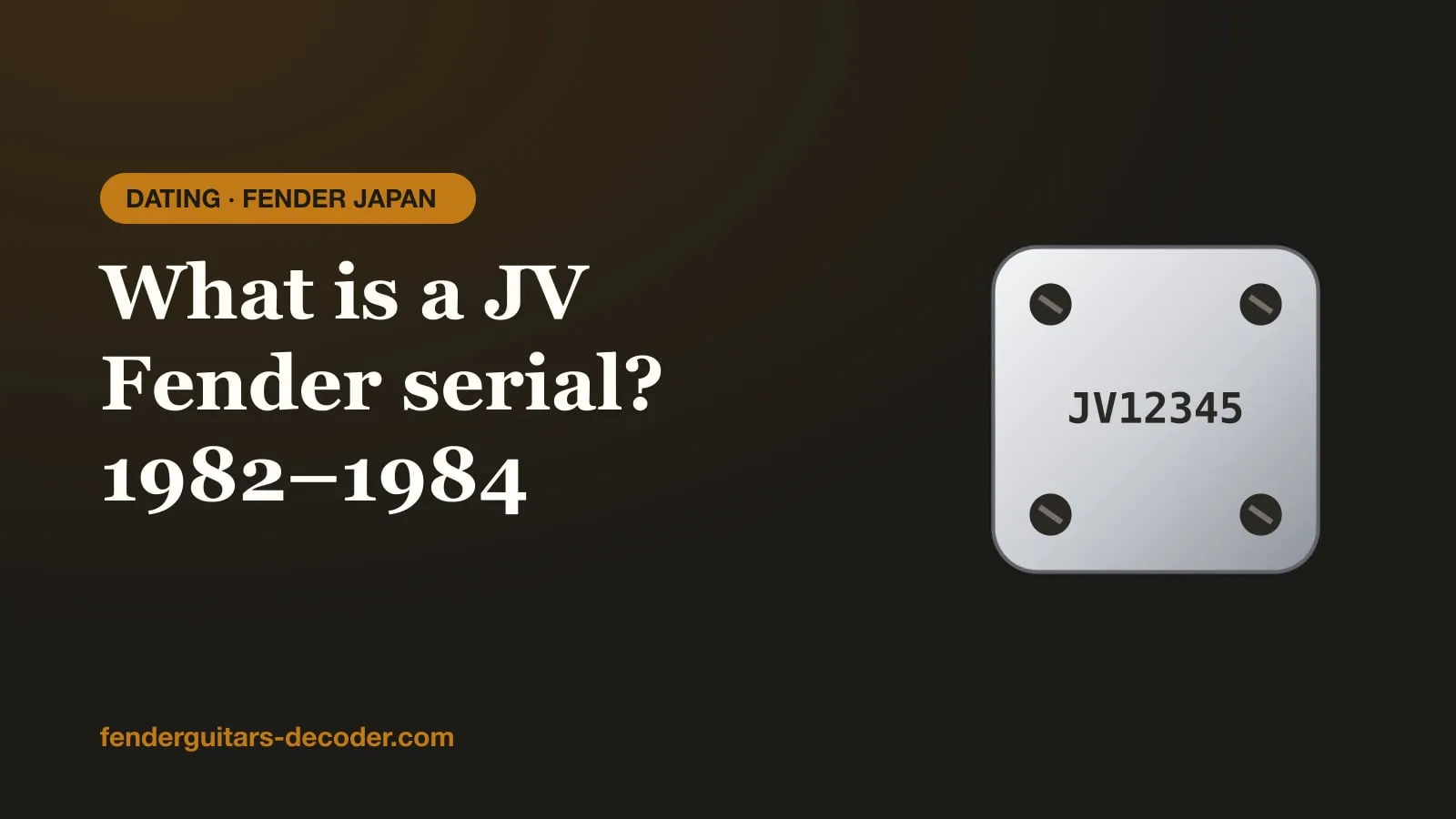
A JV serial is JV followed by five digits (for example JV12345), and it marks the first guitars and basses Fender built in Japan, from 1982 to 1984, at the FujiGen factory. They were made as vintage reissues to compete with Japanese copies, and both Fender- and Squier-branded instruments carry it. Collectors want them because they were built to a high standard, in small numbers, at the very start of Fender Japan.
Key points
- JV + 5 digits = 1982–1984, made by FujiGen in Japan. Fender’s own dating chart gives that range.
- “JV” is usually read as “Japan Vintage”: the first models were ’57 and ’62 Stratocaster reissues.
- Fender and Squier guitars both use JV serials. The logo tells you the brand, not the serial.
- The serial is usually on the four-bolt neck plate, not on the headstock.
- SQ serials (1983–1984) are their Squier cousins; from 1984 Fender Japan moved to the E series.
What JV means on a Fender
Fender Japan was set up in 1982 as a joint venture to build affordable Fenders in Japan, and FujiGen Gakki in Matsumoto was chosen as the factory. The first Japanese Stratocasters, ’57 and ’62 vintage reissues, were presented in Tokyo in May 1982, and their serials began with JV. Fender has never published an official meaning for the letters, but collectors read them as “Japan Vintage”.
Fender’s support page for Japanese instruments dates JV + 5 digits to 1982–1984 and SQ + 5 digits to 1983–1984, and it warns that serials should only be used as a guide. After that, Fender Japan switched to letter series (E, A, B, C…) that our Fender Japan serial chart covers year by year.
| Serial | Years (Fender chart) | Maker | Typical brand on the headstock |
|---|---|---|---|
| JV + 5 digits | 1982–1984 | FujiGen | Fender, Fender Squier Series, Squier by Fender |
| SQ + 5 digits | 1983–1984 | FujiGen | Squier by Fender |
| E + 6 digits | 1984–1987 | FujiGen | Fender (Made in Japan) or Squier |
| JD + 8 digits | 2012–today | — | Fender (Made in Japan) |
Where to find the JV serial
On most JV guitars and basses the serial is stamped on the four-bolt neck plate, the metal plate on the back where the neck meets the body, together with the Fender name. This copies the American guitars of the 1950s and early 1960s that the JV models reissued. Modern Japanese Fenders put the serial on the headstock instead, so if you are used to those, look at the back of the body first.
If the neck plate has been replaced, the serial is gone with it. The serial location guide shows the other places on a Fender that carry dates.
Found a JV or SQ number on the neck plate?Type it in to confirm the period, the factory and what to check next.
Open the decoderFender JV or Squier JV?
The Squier name arrived on Fender’s Japanese guitars in 1982, first for export markets such as Europe. During 1982 the headstock decal changed from a Fender logo with small “Squier Series” wording to a large Squier logo with “by Fender” in small letters. The serial system did not change: all of them used JV serials until the SQ series came in 1983.
| Headstock logo | What it suggests |
|---|---|
| Fender logo, no Squier wording | Fender Japan JV, mainly for the Japanese market |
| Fender logo with small “Squier Series” | Early export JV, 1982 |
| Large “Squier”, small “by Fender” | Squier JV (from 1982) or SQ (1983–1984) |
Collectors don’t treat the Squier JVs as second best. They came off the same FujiGen line in the same years, which is why “Squier JV” guitars often sell for far more than later Squiers. The Squier serial chart lists every Squier factory code after JV and SQ.
Which models have JV serials?
The JV range was built around reissues of classic American Fenders:
- Stratocaster: ’57 reissue (maple neck) and ’62 reissue (rosewood fingerboard), the first JV models.
- Telecaster: ’52-style reissues.
- Basses: Precision Bass and Jazz Bass reissues.
- Squier Standard models from 1983, such as the SST Stratocasters, also turn up with JV serials, so a JV serial does not always mean a vintage reissue.
Model names, finishes and specs changed during the run, and some early ’62 reissues were made with a flatter fingerboard radius than the original. Our Stratocaster dating guide explains how to compare the details of a Strat with its serial.
A JV neck plate is not proof on its own. Neck plates are easy to swap, and a JV plate on a later Japanese body or neck doesn’t make the guitar a JV. Check that the rest of the guitar fits the period: the logo style, the “Made in Japan” marking and the date on the neck heel. Our guide on how to spot a fake Fender serial lists the warning signs.
How to narrow down the year
The JV serial alone only gives you 1982–1984. To get closer:
- Read the logo. A Fender logo with “Squier Series” points to 1982; the large Squier logo to late 1982 onwards.
- Remove the neck. Japanese necks from this period are often marked at the heel with a date or a model code. Our guide on how to read a Fender neck date explains the usual formats.
- Compare the serial with documented examples. Collector registers of JV serials with known neck dates help, but the numbers were not issued strictly in order, so treat any match as a hint, not a date.
- Check SQ against JV. If the guitar is a Squier with an SQ serial, it is from 1983–1984, the end of the run.
Why collectors want JV guitars
Three things make JVs sought after:
- They were first. JV guitars are the original Fender Japan instruments, built while Fender was relaunching itself after the CBS years.
- Build quality. FujiGen built them as accurate reissues of 1950s and 1960s Fenders, and players often compare them favourably with American guitars made in the same years.
- Short run. About two years of production, before the E series took over in 1984.
If you want to know how Fender’s American guitars from the same period compare, see pre-CBS vs CBS Fender for the background to the early 1980s reissues.
What is a JV Fender worth?
We don’t publish prices, because they change every month. What moves the value of a JV is the model (a ’57 or ’62 Strat reissue usually more than a Standard Squier), the brand on the headstock, the originality (original pickups, neck, plate and finish), the condition and the paperwork. A refinished or partsed-out JV is worth much less than an all-original one.
To value one, look up completed sales of the same model and logo in similar condition on a price guide or marketplace, not asking prices. Our article on finding a Fender’s value by serial number explains what the serial can and can’t tell you.
Check the label too. JV guitars say “Made in Japan”. “Crafted in Japan” was only used from the late 1990s, so a “Crafted in Japan” guitar with a JV plate has a replaced part somewhere.
Quick checklist
- Find the serial on the neck plate: JV or SQ + five digits.
- Date the range: JV = 1982–1984, SQ = 1983–1984.
- Read the logo: Fender, Fender Squier Series or Squier by Fender.
- Check the parts agree: “Made in Japan”, period-correct logo, neck heel date.
- Value it with completed sales of the same model and condition.
If the serial, the logo and the neck all tell the same story, you have one of the first Fenders ever built in Japan.