How can I tell if my Fender is pre-CBS?
A pre-CBS Fender was built before CBS bought the company in January 1965. How to tell pre-CBS from CBS with the serial, the neck date, the logo and the pots.
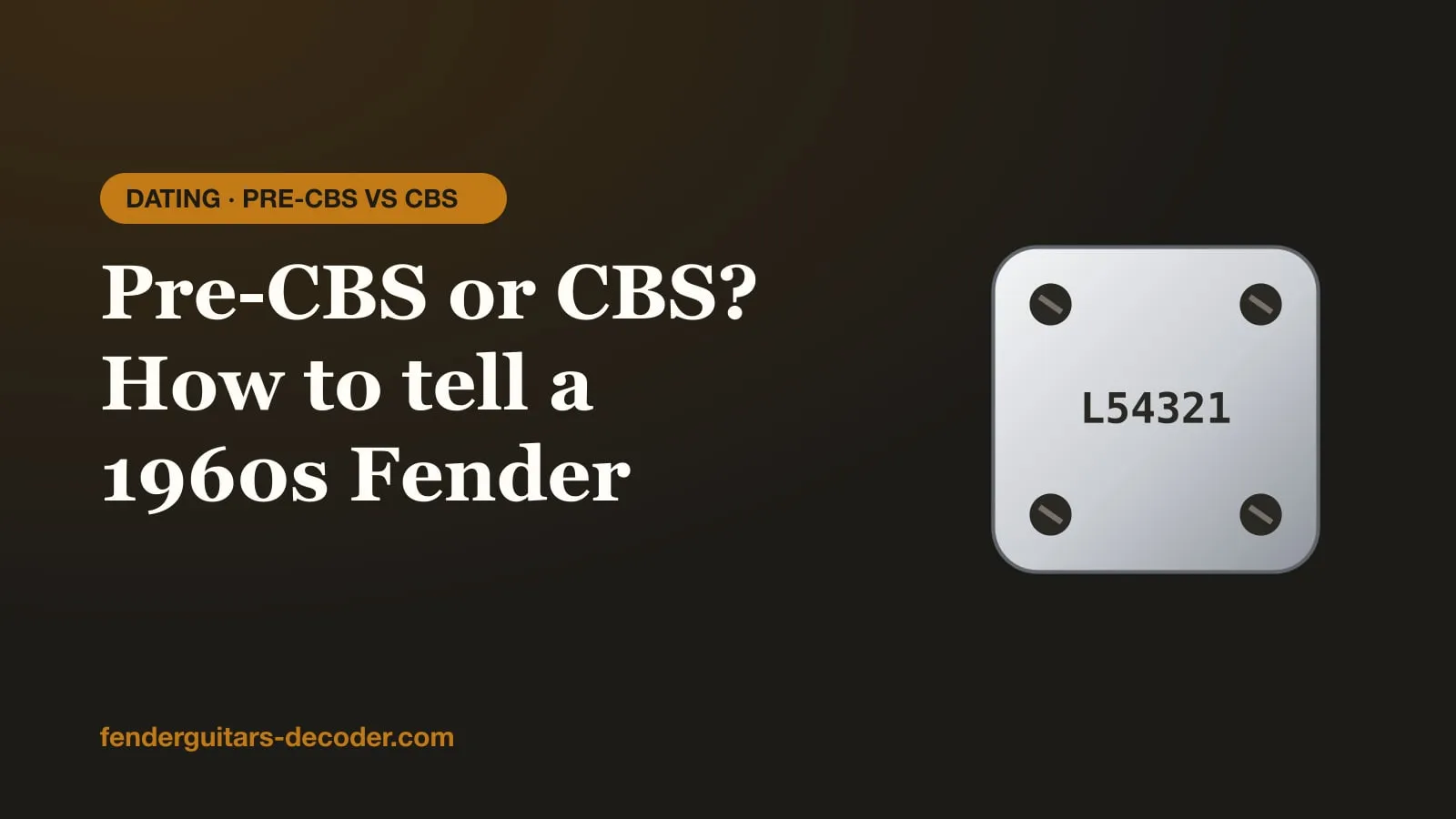
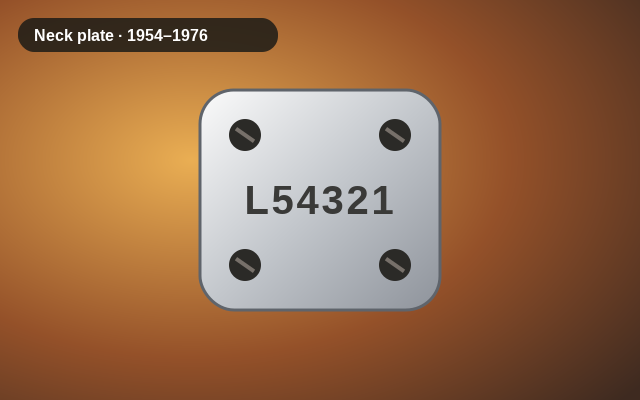
A Fender is pre-CBS if it was built before CBS bought the company in January 1965. The serial gives the first clue: plain four- or five-digit numbers and L + five digits on the neck plate belong to the pre-CBS years, while six-digit numbers on a plate stamped with a big F belong to the CBS era. Because plates were used out of order, the date on the neck heel and the pot codes are what really settle it.
Key points
- Pre-CBS = made before January 1965, in Leo Fender’s Fullerton company. CBS era = 1965 to 1985.
- Serial: plain digits (1950–1963) and L series (1963–1965) are pre-CBS or very early CBS; F neck plates (1965–1976) are CBS.
- Neck date: a heel date from 1964 or earlier is the strongest sign of a pre-CBS neck.
- 1965 guitars can be either. Mixed features are normal: collectors call them transition guitars.
- Never rely on one clue. Plates, necks and pickguards are easy to swap.
Why the CBS sale matters
In January 1965 Leo Fender sold his company to the broadcaster CBS. Production stayed in Fullerton, California, but over the following years the instruments changed: new logos, a bigger Stratocaster headstock, new neck plates, and later the three-bolt neck. Collectors treat the sale as a dividing line, and pre-CBS instruments are usually the most sought-after Fenders. That is why the question “is it pre-CBS?” comes up every time a 1960s Fender is sold. The offset models changed too: a CBS-era Jazzmaster gained a bound neck and then block inlays, and here is how to date a Fender Jazzmaster by its serial and features.
The change did not happen overnight. Necks and bodies already made in 1964 kept being assembled after the sale, and new features were introduced one by one through 1965 and 1966. A guitar finished in spring 1965 can therefore be built almost entirely from pre-CBS parts.
The serial number: your first clue
On American Fenders up to 1976 the serial is stamped on the neck plate (on early Telecasters, Esquires and Precision Basses, on the bridge plate until 1954). The format tells you which side of the line you are probably on. The same formats apply to the one-pickup Esquire, which was made until 1969 (how to tell an Esquire from a Telecaster).
| Serial on the plate | Approximate years | Pre-CBS or CBS? |
|---|---|---|
| 4–5 digits, no letter | 1950–1963 | Pre-CBS |
| L + 5 digits | 1963–1965 | Pre-CBS, except the last plates used in 1965 |
| 6 digits, F-stamped plate, 100000s | 1965–1967 | Early CBS (some with pre-CBS parts) |
| 6 digits, 200000s and up | 1966–1976 | CBS |
| S6–S9, 76 + 5 digits on the headstock | 1976–1981 | Late CBS |
| E0–E4 on the headstock | 1979–1988 | End of CBS and first post-CBS years |
The ranges overlap because plates were taken from a bin in no particular order. A low L-series number is almost certainly pre-CBS; a high L number (L8xxxx–L9xxxx) or a low 100000 on an F plate sits right on the line, and only the neck and body can tell you more.
Got a serial off a 1960s Fender?Type it in and see the year range and the era it belongs to.
Open the decoderThe neck date: the clue that decides it
Take the neck off (loosen the strings and remove the four neck screws) and look at the heel. Fender marked necks with a pencil date or a rubber stamp showing the month and year, sometimes with the builder’s initials or a model code (how to read each format). Many bodies also carry a date in the neck pocket or under the pickguard.
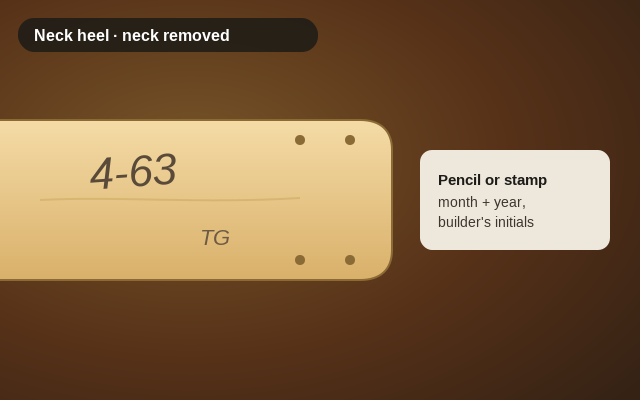
How to read what you find:
- Neck and body dated 1964 or earlier → pre-CBS parts, even if the guitar was assembled in early 1965.
- Neck dated 1965, features still pre-CBS → a transition guitar. Ask a specialist how the market treats that exact mix.
- Neck dated 1966 or later → CBS era, whatever the plate says.
- No date, or a date that disagrees with everything else → the neck may have been replaced. Check the next section before you trust it.
Swapped and faked parts
Pre-CBS parts are worth more than CBS parts, so necks, plates and pickguards migrate between guitars, and L-series plates and heel dates are faked. A pre-CBS claim needs several clues that agree, not just one.
Other features that changed after 1965
These are the changes collectors use most often as cross-checks. Dates are approximate, because Fender used up old parts before switching.
| Feature | Pre-CBS (to 1964) | CBS era (1965 onwards) |
|---|---|---|
| Neck plate | Plain plate with the serial | Plate stamped with a large F logo (from 1965) |
| Headstock logo | Thin gold “spaghetti” logo, then the gold transition logo | Transition logo (gold with black outline) into the late 1960s, then a bold black logo |
| Stratocaster headstock | Small headstock | Larger headstock from about late 1965 |
| Rosewood board dots | Clay dots | Pearloid dots from about 1965 |
| Jazz Bass neck | Unbound, dot inlays | Binding (1965–1966), then block inlays |
| Stratocaster neck joint | Four bolts | Four bolts until 1971, then a three-bolt plate and bullet truss rod |
None of these proves a date on its own: a logo decal can be added and tuners and pickguards are replaced all the time. They are useful because a real pre-CBS guitar shows several of them together, and they must agree with the neck date.
Pot codes: a quick check without removing the neck
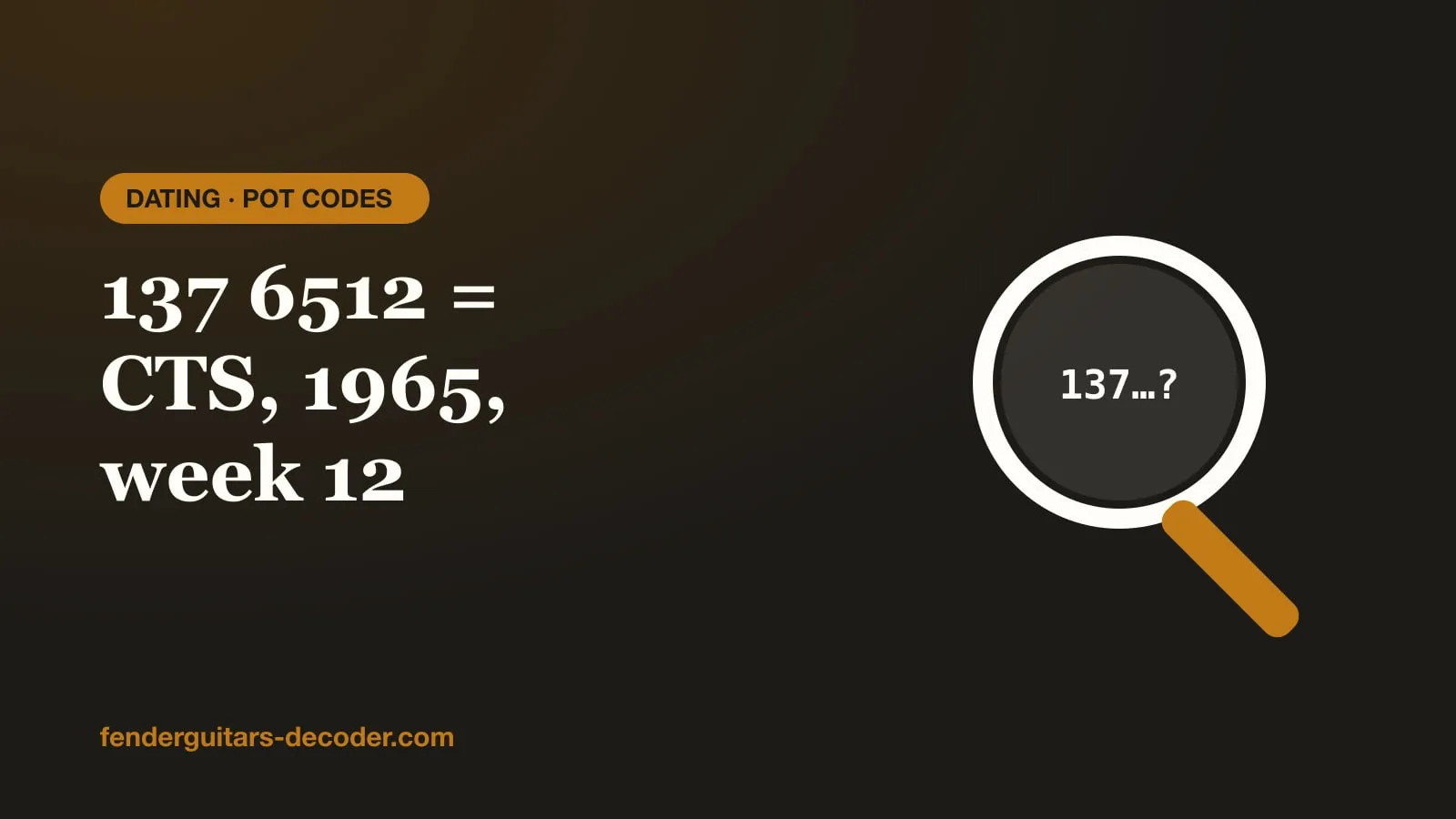
Remove the pickguard (or look through the control cavity on a Telecaster) and read the code stamped on the volume and tone pots. CTS pots, the most common on Fenders of the period, start with 137, followed by the year and the week of manufacture.
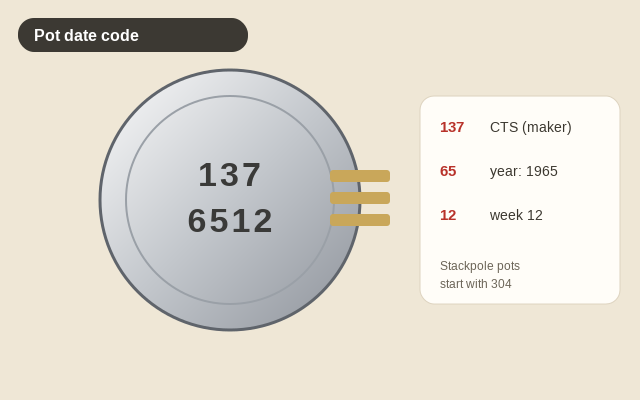
Pots dated 1964 or earlier support a pre-CBS build; pots from 1965 onwards point to a CBS-era guitar or a transition one. Pots are also replaced, so treat them as one more vote, not the verdict. Stackpole pots (code 304) and three-digit dates are read differently: how to read Fender pot codes covers every format.
Ask for these photos before buying
Neck heel (date and stamps), neck pocket, the full neck plate, pots with the codes visible, the pickups from below and the headstock logo in good light. A seller with a genuine pre-CBS Fender usually has them or can take them.
What a pre-CBS Fender is worth
It depends on the model, originality (original finish, parts and solder joints), condition, refinishing and documentation, not on the label “pre-CBS” alone. Two guitars from the same month can be worlds apart if one has a replaced neck or a refinish. Use completed sales of comparable instruments in price guides and auction results, and read what a serial number can and can’t tell you about value. For a guitar of this age, an in-person inspection by a vintage specialist is money well spent; it also protects you from the fakes that target this era.
Quick summary
- Plain-digit or low L-series plate + 1964 or earlier neck date + matching pots → pre-CBS.
- High L or low F-plate serial + 1965 dates + mixed features → transition guitar.
- F plate in the 200000s or later, or a headstock serial → CBS era.
Start with the serial in the decoder, then confirm with the neck. For the full method across every era, see how to date a Fender.