How do I read the pot codes on my Fender?
Pot codes like 137 6512 tell you when the volume and tone pots in your Fender were made. How to read the maker code, year and week, and what they prove.
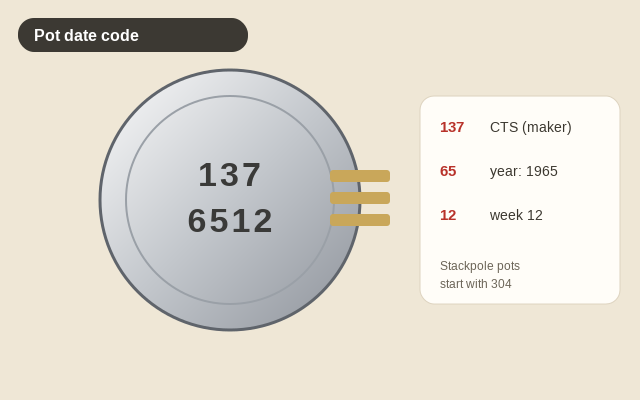
A Fender pot code is the number stamped on the back or side of each volume and tone potentiometer. On American pots it is an EIA source-date code: three digits for the maker (137 for CTS, 304 for Stackpole), then the year and the week it was made. 137 6512, for example, reads CTS, 1965, week 12. The guitar was wired after that date, so the code gives you the earliest possible year for the electronics.
Key points
- The code has two parts: a 3-digit maker code and a date (year + week).
- 137 = CTS, 304 = Stackpole, the two names you will meet most often on US Fenders.
- From the 1960s the date has 4 digits: two for the year, two for the week (01 to 52). Older codes use one digit for the year, so you have to work out the decade.
- Pots are made before the guitar. A guitar is the same age as its pots or newer, sometimes by more than a year.
- Imported pots (most Mexican, Japanese and Asian Fenders and Squiers) usually have no EIA date code.
Where to find the pot codes
On a Stratocaster the three pots are fixed to the pickguard, so you have to loosen the strings and lift the pickguard to see their backs. On a Telecaster they sit on the control plate: remove its two screws and tilt the plate out of the cavity. On a Jazz Bass or Precision Bass they are under the control plate as well. The code is stamped or inked on the back of the metal case, sometimes on the side, and solder can cover part of it.
Don’t scrape off the solder
On a vintage Fender, original solder joints are part of what buyers check. If a blob of solder hides part of the code, read what you can with a torch at a low angle and a magnifier, and photograph it. Scraping or reflowing the joint to see the code lowers the value of an all-original instrument.
How to read the code, step by step
Take 137 6512, the most typical format on a 1960s Fender:
- 137: the maker. This is the manufacturer’s number in the EIA source code list. 137 is CTS (Chicago Telephone Supply).
- 65: the year. Two digits from about 1960 onwards, so 65 is 1965.
- 12: the week of the year. It runs from 01 to 52. Week 12 falls in late March.
Sometimes there is a space or a hyphen between the maker code and the date (137-6512), and sometimes there isn’t (1376512). If the last two digits are higher than 52, what you are reading is not a source-date code: it is probably a part number or the resistance value.
Maker codes you are likely to see
These are the three-digit EIA codes listed by vintage guitar references for the common pot makers. Only the first two appear regularly on Fender guitars; the others turn up on other brands, on amps or on replacement parts.
| Code | Maker | Where you usually see it |
|---|---|---|
| 137 | CTS | Most US Fenders from the 1960s on, and many replacement pots |
| 304 | Stackpole | Typical of 1950s and early 1960s Fenders |
| 134 | Centralab | Other US guitars and amps of the period |
| 106 | Allen-Bradley | Mostly amps and other equipment |
| 140 | Clarostat | Other US instruments and equipment |
| 381 | Bourns | Later equipment and some replacement pots |
Collector references agree that 1950s Fenders mostly used Stackpole pots and that CTS took over in the 1960s. They disagree on exactly when: one dating reference gives roughly early 1963, other guides say around 1966, and transition guitars can mix both. Treat a Stackpole pot as normal on a 1950s or early 1960s Fender, and a CTS pot as normal from the mid-1960s, without using the brand alone to date the guitar.
Fender amps use the same EIA idea on their transformers, where the code starts with 606 and is followed by the year and the week. If you own the amp that came with your guitar, our guide on how to date a Fender amp explains those codes and the two-letter date stamps.
Do the pots agree with the serial?Enter the serial from the neck plate or headstock and check that its year range starts on or after the pot date.
Open the decoderThree-digit dates: working out the decade
Before about 1960 most pot codes used a single digit for the year. Stackpole, for one, is reported to have moved from three-digit to four-digit dates in late 1959. A code such as 304 742 therefore reads Stackpole, a year ending in 7, week 42: 1947, 1957 or 1967 on paper. On a Fender the answer is almost always obvious from the rest of the guitar (the Telecaster family only starts in 1950, and a 1967 guitar would normally carry a four-digit date), but always settle the decade with the serial and the neck date.
| Code on the pot | Format | Reads as |
|---|---|---|
| 304 742 | Maker + 1-digit year + week | Stackpole, year ending in 7 (1957 on a 1950s Fender), week 42 |
| 137 6512 | Maker + 2-digit year + week | CTS, 1965, week 12 |
| 1377624 | Same, without a space | CTS, 1976, week 24 |
| 1407 (alone, on a recent CTS pot) | Date only, next to a part number | 2014, week 7 |
Recent CTS pots often drop the 137 and carry a long part number plus a separate four-digit date, as in the last row. The logic is the same: two digits for the year, two for the week.
What the pot date proves
Pots were bought in large batches and used as they came off the shelf, so a pot date is the earliest date the guitar could have been wired, not the day it was built. A gap of a few weeks to several months is normal; vintage references mention gaps of up to about a year and a half, and longer on models that sold slowly. There are also reports of a large CTS stock bought in the mid-1960s that kept turning up in Fenders built years later, which is why late-1960s and early-1970s guitars can have pots from 1966 or 1967.
| What you find | What it suggests |
|---|---|
| Pots a few months older than the neck date and serial | Normal: everything is probably original |
| All pots with the same or close dates | A consistent set from one batch |
| One pot much newer than the others | That pot was probably replaced |
| Pots dated after the serial range and the neck date | Replacement pots (or a later rewire) |
| Pots more than two years older than everything else | Possible, but check the wiring and solder for signs of a swap |
This is why dealers read pots together with the date on the neck heel and the serial. On a pre-CBS candidate, pots dated 1964 or earlier support a pre-CBS build, while a set of 1966 pots in a guitar sold as a 1963 is a question you should ask before paying.
Photograph every pot code
When you have the pickguard or control plate off, take a sharp photo of each pot code and of the solder joints. With the neck heel photo, it is the most useful record you can keep with a vintage Fender, and serious buyers will ask for it.
When pot codes don’t help
On many modern and imported Fenders the pots are made outside the US and carry no EIA source-date code, or only a part number and a value such as 250K or 500K. That is normal and says nothing about whether the guitar is genuine. On a Mexican, Japanese, Indonesian or Chinese Fender or Squier, the serial number is the main dating evidence: see the Mexico and Squier charts.
Pots are also one of the easiest parts to replace, and a fresh CTS pot with a vintage-looking date is easy to find. Codes that look right are one more vote for an original guitar, not proof. For high-value instruments, read how to spot a fake Fender and have a specialist look at the wiring.
Quick summary
- Lift the pickguard or control plate and read the number on the back of each pot.
- First three digits = maker (137 CTS, 304 Stackpole). Then year and week: 137 6512 = CTS, 1965, week 12.
- A one-digit year (pre-1960) means you choose the decade from the rest of the guitar.
- The guitar is the same age as its pots or newer. Pots dated after the serial and neck date are replacements.
- Compare everything with the serial in the decoder and the full dating method.