My Fender says “Corona, California”: what year is it?
Corona is where Fender has built its American guitars since 1985. Which serials come from Corona (E, N, Z, US, V, Custom Shop) and how to date yours.
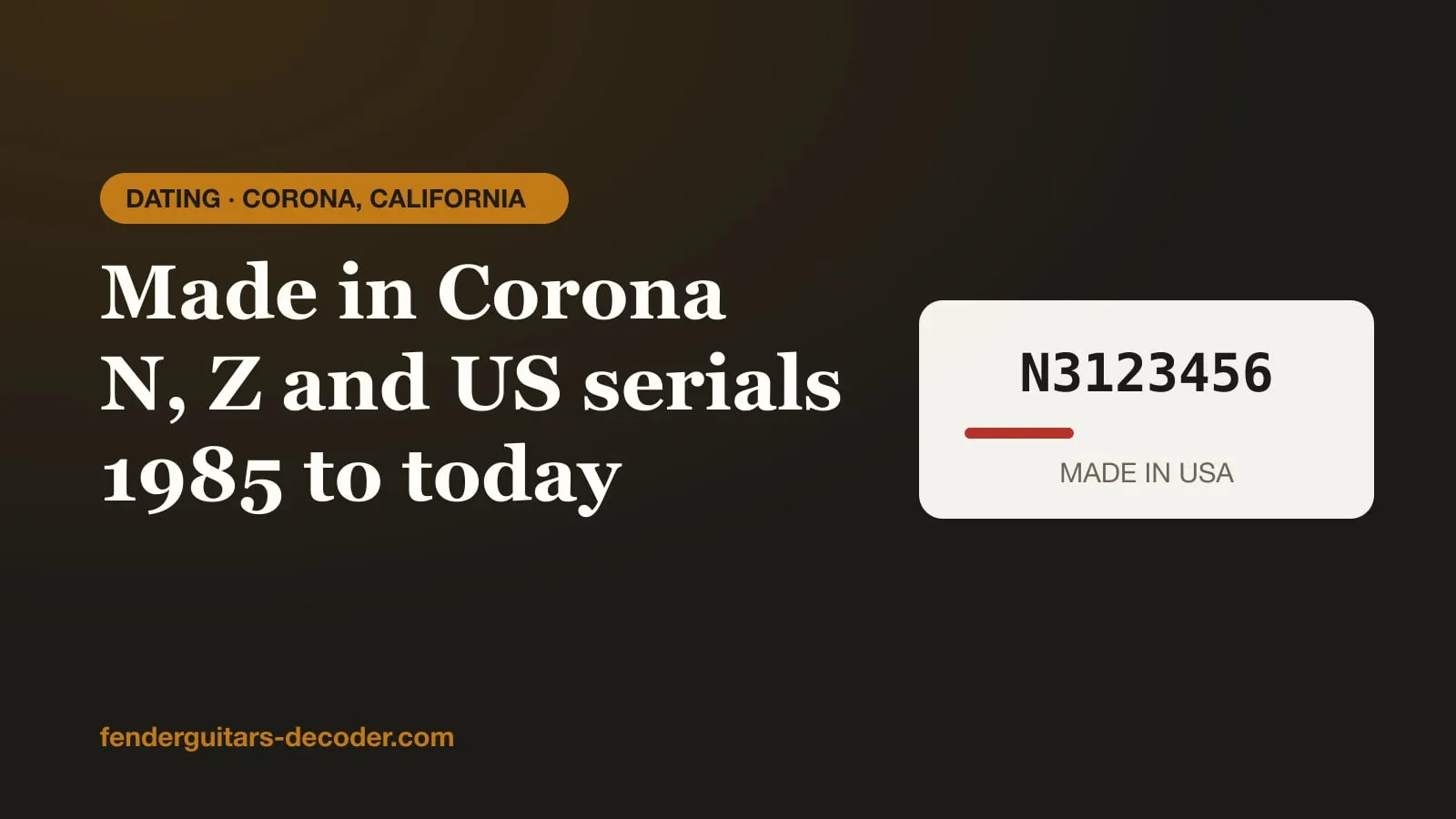
“Corona, California” tells you where your Fender was made, not when. Corona is the town where Fender has built its American guitars and basses since late 1985, so any Fender made there is from 1985 or later. The year comes from the serial number: an N serial means the 1990s, Z the 2000s and US plus two digits 2010 or later, with the exact year in the digits.
Key points
- Corona = Fender USA since 1985. Everything American before that was made in Fullerton.
- Serial formats from Corona: late E (1985–1990), N and DN (1989–2000), Z and DZ (2000–2010), US + year (2010 to today), V (American Vintage), and the Custom Shop prefixes (from 1987).
- The digit after N or Z is the year: N3 = 1993, Z5 = 2005. After US, two digits: US21 = 2021.
- Ensenada is in Baja California, Mexico. A Mexican Fender is not a Corona Fender.
Why Fender moved to Corona
From 1946 Fender built everything in Fullerton, California, first under Leo Fender and from January 1965 under CBS. In early 1985 CBS sold Fender to a group of its managers. The Fullerton factory was not part of the sale, so for several months there was no American production at all, and the company relied on guitars from Fender Japan.
American production restarted in Corona, California, late in 1985 with a small team. The American Standard Stratocaster, introduced in 1986, was one of the first new models built there, and the Fender Custom Shop opened in Corona in 1987. Corona has been Fender’s American factory ever since: an American Professional II or an American Ultra made today comes from the same plant.
That history gives you a simple rule. If a guitar was made in Corona, it was made after 1985. If it is supposed to be older, it must be a Fullerton guitar, and its serial should be one of the earlier American formats.
Which serial numbers come from Corona?
These are the American formats used since production moved. The decal is on the back of the headstock unless the table says otherwise.
| Serial | Years | What it is | Year in the serial? |
|---|---|---|---|
| E4–E9 | 1985–1990 | Late E series, front or back of headstock | Roughly; E4 runs 1984–1988 |
| N9 (first use) | 1989–1990 | Start of the N series | Yes |
| N0–N8 | 1990–1999 | 1990s production (American Standard, Strat Plus…) | Yes: N3 = 1993 |
| N9 (second use) | 1999–2000 | End of the decade | Yes, but see below |
| DN + digit | late 1990s | American Deluxe | Yes |
| Z0–Z9 | 2000–2010 | American Series, American Standard | Yes: Z5 = 2005 |
| DZ + digit | 2000s | American Deluxe | Yes |
| US + two digits | 2010–today | Every USA production line | Yes: US21 = 2021 |
| V + digits | 1985–today in Corona | American Vintage reissues, on the neck plate | No |
| CN, XN, CZ, R | 1987–today | Fender Custom Shop | Mostly no |
The serial year is the year the decal was made or applied, and Fender often had a few months of overlap into the next year. For N and Z serials the year is right within about a year; for US serials, almost always exact.
Got the serial in front of you?Type it in and get the year range, the factory and a link to the right chart.
Open the decoderHow to read a Corona serial, step by step
- Find the serial. On almost every Corona guitar it is a decal on the back of the headstock, next to “Made in USA”. American Vintage reissues and many Custom Shop guitars have it stamped on the neck plate instead. Not sure where to look? Here is where the serial is on every kind of Fender.
- Read the letters. N, Z or US means standard USA production. D before N or Z means American Deluxe. V means American Vintage. CN, XN, CZ or R points to the Custom Shop.
- Read the first digit or digits. After N or Z, one digit is the year of that decade. After US, two digits are the year. A serial such as N3123456 is a Corona guitar from about 1993; US21012345 is from 2021.
- Check the country printed with it. It should say Made in USA. If it says Made in Japan, Mexico or anywhere else, the guitar is not from Corona, whatever the listing says.
- Confirm with the neck date if the year matters. Corona necks are dated in the heel and the body is dated in the neck pocket; here is how to read the date on a Fender neck.
California is not Baja California
Fender’s Mexican factory is in Ensenada, Baja California, a few hours south of Corona. Mexican serials start with MN, MZ or MX, and the decal says Made in Mexico. A seller who describes an MX-serial Stratocaster as “made in California” is either confused or hoping you are. Here is how to tell a Mexican Fender from an American one.
The tricky cases: E4 and N9
Two prefixes cross the line between eras, and both are common on the used market.
E4. E4 decals were used from 1984 to 1988, longer than any other prefix, because leftover decals carried over from Fullerton to Corona. An E4 guitar can therefore be one of the last Fullerton instruments or one of the first Corona ones. The serial cannot tell you which; the neck date and the model can. An American Standard Stratocaster, for example, did not exist before 1986, so an E4 American Standard is a Corona guitar.
N9. Fender used N9 twice: from late 1989 into 1990, and again in 1999. Both are Corona guitars, so the factory does not help. The neck date settles it, and so does the model: a series that only started in the late 1990s cannot be from 1989.
| Clue | Late Fullerton (to early 1985) | Early Corona (late 1985 onwards) |
|---|---|---|
| Serial | E2, E3, early E4, early V | Late E4, E7–E9, N9, V |
| Typical models | Vintage reissues, the 1983–1984 “Standard” and Elite lines | American Standard Stratocaster (from 1986), American Vintage reissues |
| Neck date | 1985 or earlier | Late 1985 or later |
| What to do | Compare with the pre-CBS and CBS guide | Date it from the neck heel and pots |
Fullerton or Corona reissue?
The first American Vintage reissues were built in Fullerton from 1982 until early 1985, and collectors pay more for them than for later Corona reissues. Both carry a V serial on the neck plate and the serial does not encode the year, so the neck date is the only reliable way to tell which side of the move a reissue was made on.
Is a Corona Fender worth more?
“Corona” on its own does not change the value: almost every American Fender of the last four decades was made there. What matters is the model, the year, originality and condition. A few Corona-era guitars do have a following, such as the first American Standards of 1986–1987 and some 1990s limited editions, but prices depend on what similar guitars have actually sold for. To estimate a value, look up completed sales of the same model and year, and read what a serial number can and cannot tell you about value.
Quick summary
- Corona, California is Fender’s American factory since late 1985; before that, Fullerton.
- A Corona Fender has an E (late), N, DN, Z, DZ, US, V or Custom Shop serial and says Made in USA.
- N and Z plus one digit, or US plus two digits, give you the year.
- E4, N9 and V serials need the neck date to pin down the year.
- A Mexican Fender is made in Ensenada, Baja California, not in Corona.
- Not sure what you have? Paste the serial into the decoder and it will show every possible match.