How old is my Fender Jazzmaster? Dating it by serial number
Date a Fender Jazzmaster by serial number: neck plate serials from 1958 to 1976, headstock decals after that, and the formats on Japanese, Mexican and Squier models.
You date a Fender Jazzmaster the same way as any other Fender: from the serial number and the country printed with it. On an original American Jazzmaster made between 1958 and 1976 the serial is stamped on the neck plate; from 1976 to the end of the original run in 1980 it is on a headstock decal. Reissues and modern Jazzmasters use the serial system of the factory that built them: Japan, the USA, Mexico or a Squier plant in Asia.
Key points
- 1958–1976: serial on the neck plate. Plain numbers to 1963, L + 5 digits from 1963 to 1965, six digits on the “F” plate from 1965.
- 1976–1980: serial on a headstock decal, as on every American Fender of the period.
- Reissues and modern models: Japan (JV, E, A, letter + digits), USA (V on vintage reissues, US + year on the rest), Mexico (MZ, MX + year) and Squier (factory codes from China and Indonesia).
- The serial dates the neck plate or decal, not the whole guitar. Confirm a vintage Jazzmaster with the neck date and the pot codes.
A short history of the Jazzmaster
Fender introduced the Jazzmaster in 1958 as its new top-of-the-line guitar, aimed, as the name says, at jazz players. It brought several firsts for Fender: the offset-waist body, a rosewood fingerboard, the floating vibrato with a lock, and a separate “rhythm” circuit with its own volume and tone rollers. Jazz players never took to it, but surf, indie and alternative guitarists did, and that is why there are so many reissues today.
The original American Jazzmaster stayed in the catalogue through the CBS years and was discontinued in 1980. For the next years, the only new Jazzmasters came from Fender Japan, which reissued the 1960s models in the 1980s. American vintage reissues followed later, then Mexican and Squier versions, and today there are Jazzmasters at every price level.
That history matters for dating: a Jazzmaster that claims to be American and from the early 1980s should make you look twice, because Fender was not building them in the USA then.
Where is the serial number on a Jazzmaster?
| Years | Made in | Where to look | Serial format |
|---|---|---|---|
| 1958–1963 | USA (Fullerton) | Neck plate | 5 digits, sometimes with a leading 0 |
| 1963–1965 | USA (Fullerton) | Neck plate | L + 5 digits |
| 1965–1976 | USA (Fullerton, CBS) | Neck plate with a large “F” | 6 digits |
| 1976–1980 | USA (Fullerton, CBS) | Headstock decal | 76 + digits, then S + digits |
| 1980s–today | Japan | Back of the headstock or neck heel | JV, E, A, letter + digits, JD |
| Vintage reissues | USA | Neck plate | V + digits |
| Modern production | USA (Corona) | Back of the headstock | US + two-digit year |
| Modern production | Mexico (Ensenada) | Back of the headstock | MZ, then MX + year |
| Squier | China, Indonesia | Back of the headstock | CY, CGS, ICS, ISS and others |
If your Jazzmaster has no serial where the table says it should be, start with our guide to where the serial is on every kind of Fender: replacement necks and plates are common on these guitars.
Found the serial?Type it in and see the year range, the country and the chart it belongs to.
Open the decoderHow to read a vintage Jazzmaster serial
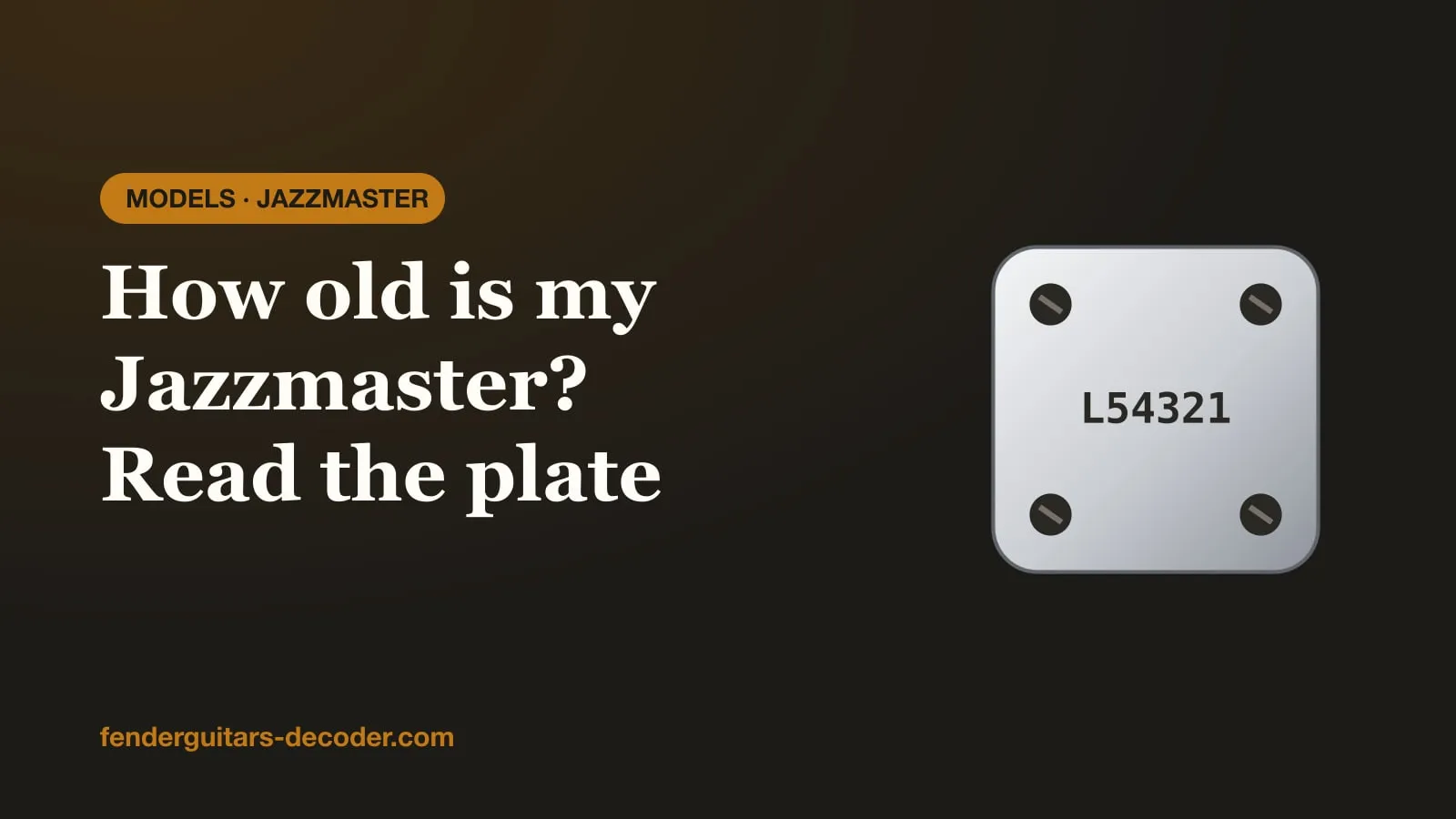
- Read the neck plate. Five digits, an L followed by five digits, or six digits on a plate with a big “F” all point to an original American Jazzmaster. A serial such as L54321 is from about 1964–1965.
- Remember that plates were used out of order. Fender stamped neck plates in batches and workers took them from a bin, so a plate can be a year or so older or newer than the guitar. Our L series and F-plate charts give the usual ranges, not exact dates.
- Check the neck date. Remove the neck and look at the heel: a pencil or stamped date there is the most reliable date on the guitar. Here is how to read the date on a Fender neck.
- Check the pots. The source date code on the potentiometers tells you the earliest the guitar could have been wired. A Jazzmaster has more pots than most Fenders, so you get several dates to compare. Here is how to read Fender pot codes.
- Compare the features with the era in the table below.
A neck plate is the easiest part to swap
On a vintage Jazzmaster the serial lives on a separate metal plate held by four screws. Plates from parts guitars, and outright reproductions, turn up on refinished and rebuilt instruments. A correct serial on its own proves very little: if the neck date, the pot codes and the features disagree with it, trust them over the plate. Our guide to spotting a fake Fender by its serial lists the warning signs.
Jazzmaster features by era
Collectors date original Jazzmasters as much by their features as by the serial. These are the broad changes to look for:
| Era | What to look for |
|---|---|
| 1958–1959 | Rosewood “slab” fingerboard (flat-bottomed), early guitars with an anodized gold aluminium pickguard, later a tortoiseshell one |
| 1962–1965 | Thinner curved rosewood fingerboard (veneer), clay dot markers, spaghetti and then “transition” logo |
| 1965–1966 | CBS ownership; bound fingerboard, then block inlays instead of dots |
| Late 1960s–1980 | Black CBS-style logo, F neck plate, then the serial on the headstock from 1976 |
None of these on its own dates a guitar to the year, but a mismatch is a clear signal. A curved board with block inlays and a five-digit plate, for example, means the plate or the neck is not original to that guitar.
The Jaguar works the same way
The Fender Jaguar, introduced in 1962, shares the Jazzmaster’s offset body and was built alongside it in Fullerton. Its serials sit in the same places and follow the same charts, so everything above applies to a vintage Jaguar too. The same goes for Fender’s smaller offsets: see how to date a Mustang or Musicmaster.
Dating a Japanese, Mexican or Squier Jazzmaster
Japan. Fender Japan Jazzmasters use the Japanese serial system: JV in the early 1980s, then E, A, B and other letter series, and JD from 2012. The country is printed with the serial (“Made in Japan” or “Crafted in Japan”), and the letter tells you the period. Some Japanese serial letters were used more than once, so read the Fender Japan chart with the country wording in mind.
USA reissues and modern models. American vintage reissue Jazzmasters have a V serial on the neck plate, which does not encode the year: date them from the neck and the paperwork. Current American production models have a US serial on the back of the headstock, where the two digits after US are the year (US21… = 2021).
Mexico. Mexican Jazzmasters have an MZ serial (2000s) or an MX serial on the back of the headstock. On recent MX serials the two digits after MX are the year. See the Mexico chart for the details.
Squier. Squier Jazzmasters, from the Vintage Modified and Classic Vibe series to the Affinity and the signature models, have been made in China and Indonesia. The letters at the start of the serial are the factory, and on most recent ones the digits after them give the year. Our guides to dating a Classic Vibe and dating an Affinity or Bullet cover those codes.
What is a Jazzmaster worth?
The serial tells you when and where a Jazzmaster was made, which is the starting point for any valuation, but it does not set the price. An original pre-CBS Jazzmaster, a CBS-era one, a Japanese reissue and a Squier are completely different markets. Originality, the finish, refinishes, replaced parts and condition all move the value a long way. To estimate it, compare completed sales of the same model and year, and read what a serial number can and cannot tell you about value.
Quick summary
- Original American Jazzmasters (1958–1980): serial on the neck plate until 1976, then on the headstock.
- Five digits, L + five digits and six-digit F plates are the vintage formats; each gives a range, not an exact year.
- Japanese, American, Mexican and Squier reissues follow their own factory’s serial system.
- Confirm any vintage Jazzmaster with the neck date, the pot codes and the features of the era.
- Not sure what you have? Paste the serial into the decoder and it shows every possible match.